What is the question?
In the previous lesson, we learned about linear combinations and span.
Given vectors
\[\mathbf v_1,\mathbf v_2,\ldots,\mathbf v_k,\]we can form combinations such as
The collection of all such combinations is their span.
But we noticed something important.
Suppose
\[\mathbf u= \begin{bmatrix} 1\\ 2 \end{bmatrix}\]and
\[\mathbf v= \begin{bmatrix} 2\\ 4 \end{bmatrix}.\]The second vector does not give us a new direction because
\[\mathbf v=2\mathbf u.\]So although we have two vectors, we really have only one direction.
This leads to the next question:
How can we tell whether a collection of vectors contains redundant vectors?
This is the idea of linear independence.
1. Start with redundancy
Consider
\[\mathbf u= \begin{bmatrix} 1\\ 2 \end{bmatrix}, \qquad \mathbf v= \begin{bmatrix} 2\\ 4 \end{bmatrix}.\]Because
\[\mathbf v=2\mathbf u,\]we can write
\[\mathbf v-2\mathbf u=\mathbf 0.\]That is,
\[-2\mathbf u+\mathbf v=\mathbf 0.\]Notice something interesting.
We have found a combination of the vectors that produces the zero vector.
And the coefficients are not all zero.
Specifically,
\[-2\neq0\]and
\[1\neq0.\]This is the key observation behind linear dependence.
2. The zero vector gives us a clue
Suppose we have two vectors $\mathbf u$ and $\mathbf v$.
Consider
\[a\mathbf u+b\mathbf v=\mathbf 0.\]There is always one obvious solution:
\[a=0,\qquad b=0.\]Then
\[0\mathbf u+0\mathbf v=\mathbf 0.\]That is not very interesting.
The important question is:
Is there another solution in which at least one coefficient is nonzero?
For our previous example,
\[\mathbf u= \begin{bmatrix} 1\\ 2 \end{bmatrix}, \qquad \mathbf v= \begin{bmatrix} 2\\ 4 \end{bmatrix},\]we found
\[-2\mathbf u+\mathbf v=\mathbf0.\]So there is a nonzero choice of coefficients that produces zero.
That tells us that the vectors are redundant.
3. The definition of linear independence
Now we can state the definition.
Vectors
\[\mathbf v_1,\mathbf v_2,\ldots,\mathbf v_k\]are linearly independent if the equation
has only the trivial solution
\[c_1=c_2=\cdots=c_k=0.\]In other words:
The only way to combine the vectors and get the zero vector is to use zero for every coefficient.
If there is a nonzero combination that gives zero, the vectors are linearly dependent.
So there are two possibilities.
Linearly independent
\[c_1\mathbf v_1+\cdots+c_k\mathbf v_k=\mathbf0\]implies
\[{ c_1=\cdots=c_k=0 }.\]Linearly dependent
There exists some choice of coefficients, not all zero, such that
\[{ c_1\mathbf v_1+\cdots+c_k\mathbf v_k=\mathbf0 }.\]4. Why zero?
You might wonder:
Why do we specifically look at combinations that equal the zero vector?
Because zero gives us a way to detect redundancy.
Suppose
\[a\mathbf u+b\mathbf v=\mathbf0\]and suppose $b\neq0$.
Then
\[b\mathbf v=-a\mathbf u.\]Divide by $b$:
\[\mathbf v = -\frac{a}{b}\mathbf u.\]So $\mathbf v$ can be constructed from $\mathbf u$.
It does not provide a genuinely new direction.
That is exactly what we mean by redundancy.
5. A simple example
Consider
\[\mathbf u= \begin{bmatrix} 1\\ 2 \end{bmatrix}, \qquad \mathbf v= \begin{bmatrix} 2\\ 4 \end{bmatrix}.\]We want to determine whether these vectors are linearly independent.
Start with
\[a\mathbf u+b\mathbf v=\mathbf0.\]Substitute the vectors:
\[a \begin{bmatrix} 1\\ 2 \end{bmatrix} + b \begin{bmatrix} 2\\ 4 \end{bmatrix} = \begin{bmatrix} 0\\ 0 \end{bmatrix}.\]Looking at the components gives
\[a+2b=0\]and
\[2a+4b=0.\]The second equation is just twice the first.
So we have only one independent equation:
\[a+2b=0.\]Therefore,
\[a=-2b.\]We can choose, for example,
\[b=1.\]Then
\[a=-2.\]So
\[-2\mathbf u+\mathbf v=\mathbf0.\]The coefficients are not both zero.
Therefore,
\[{ \mathbf u,\mathbf v \text{ are linearly dependent}. }\]6. Geometric meaning
For two vectors in $\mathbb R^2$, there is a very useful geometric interpretation.
If two nonzero vectors lie on the same line through the origin, they are linearly dependent.
For example,
\[\mathbf u= \begin{bmatrix} 1\\ 2 \end{bmatrix}, \qquad \mathbf v= \begin{bmatrix} 2\\ 4 \end{bmatrix}.\]Both point along the same line.
Their span is only a line.
So they do not provide two genuinely different directions.
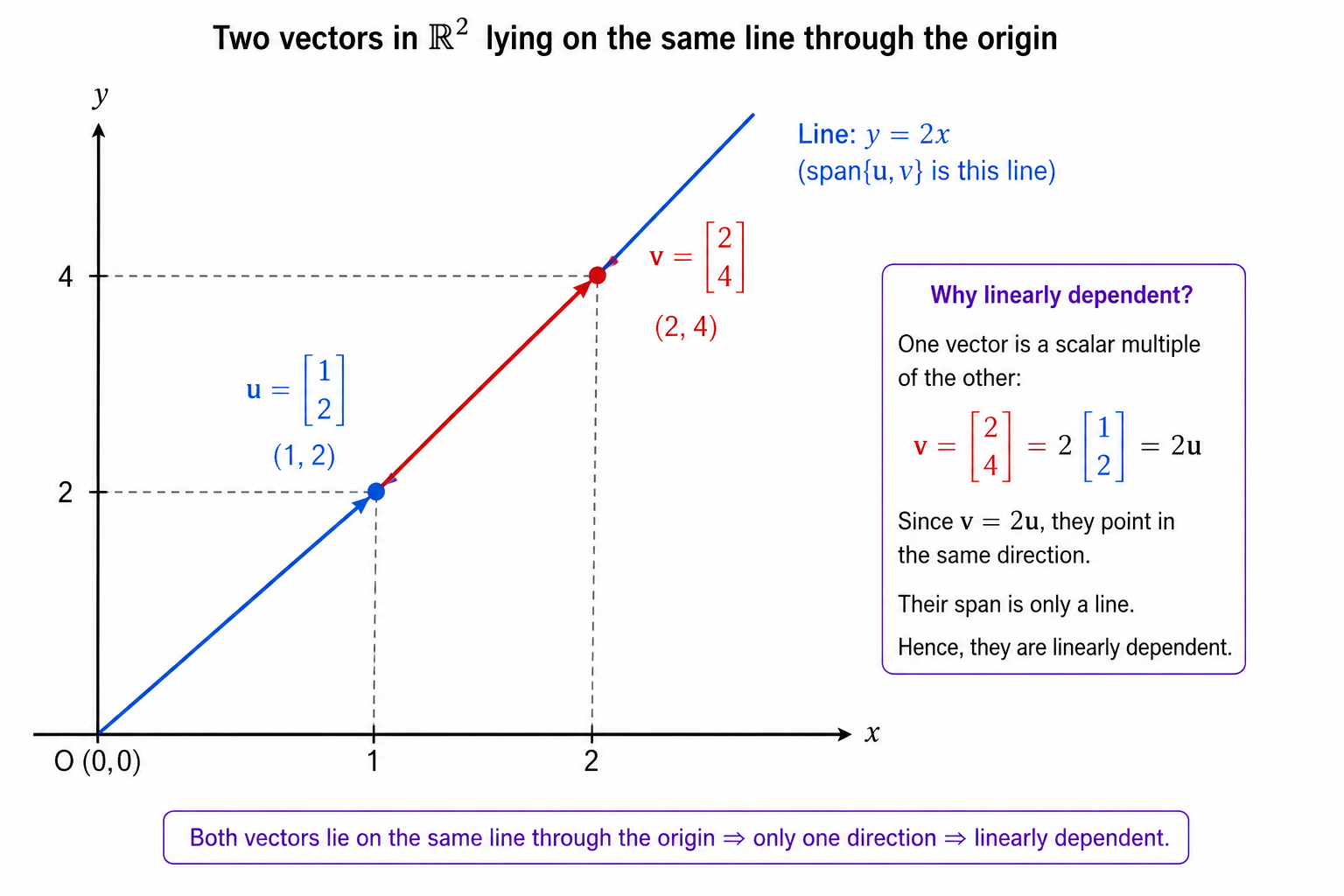
The picture is the important part:
Two vectors on the same line are dependent.
7. Two vectors pointing in different directions
Now consider
\[\mathbf u= \begin{bmatrix} 1\\ 2 \end{bmatrix}, \qquad \mathbf v= \begin{bmatrix} 2\\ -1 \end{bmatrix}.\]These vectors do not lie on the same line.
They point in different directions.
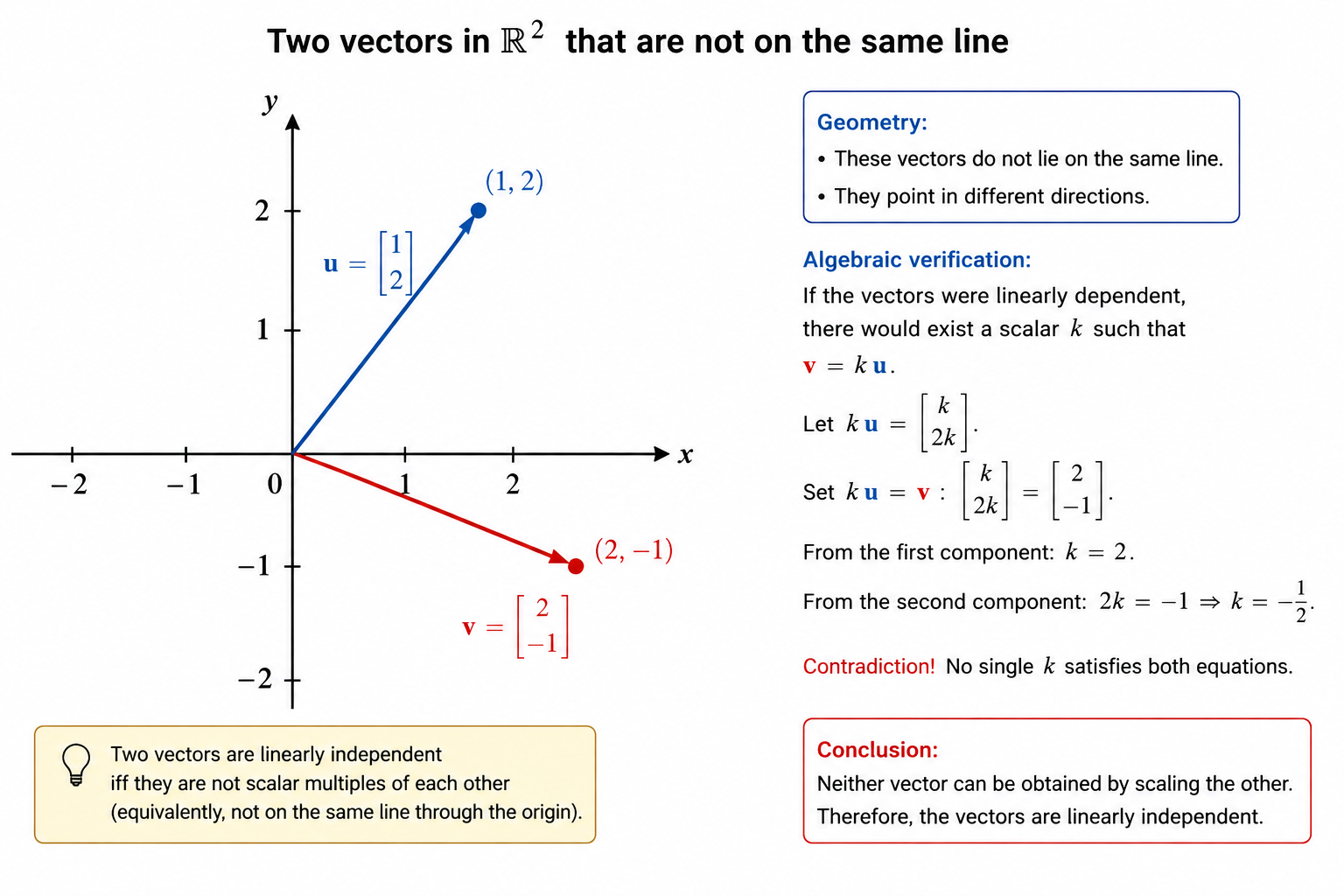
This means neither vector can be produced by simply scaling the other.
So we expect them to be linearly independent.
Let’s verify this algebraically.
8. Testing the example algebraically
Start with
\[a\mathbf u+b\mathbf v=\mathbf0.\]Substitute:
\[a \begin{bmatrix} 1\\ 2 \end{bmatrix} + b \begin{bmatrix} 2\\ -1 \end{bmatrix} = \begin{bmatrix} 0\\ 0 \end{bmatrix}.\]This gives
\[a+2b=0\]and
\[2a-b=0.\]From the first equation,
\[a=-2b.\]Substitute into the second:
\[2(-2b)-b=0.\]Therefore,
\[-5b=0.\]So
\[b=0.\]Then
\[a=0.\]The only solution is
\[a=b=0.\]Therefore,
\[{ \mathbf u,\mathbf v \text{ are linearly independent}. }\]9. What independence really means
It is tempting to memorize:
“Independent vectors point in different directions.”
That is useful in $\mathbb R^2$, but the deeper meaning is more general.
Linear independence means:
No vector in the collection can be constructed from the others.
For example, suppose
\[\mathbf v_3 = 2\mathbf v_1 - 3\mathbf v_2.\]Then
\[2\mathbf v_1 - 3\mathbf v_2 - \mathbf v_3 = \mathbf0.\]The coefficients
\[2,\quad -3,\quad -1\]are not all zero.
Therefore the three vectors are linearly dependent.
The third vector was redundant.
10. Dependence means redundancy
This is perhaps the most useful way to think about the definition.
Suppose we have
\[\mathbf v_1,\mathbf v_2,\mathbf v_3.\]If we can write
\[\mathbf v_3 = c_1\mathbf v_1+c_2\mathbf v_2,\]then $\mathbf v_3$ does not add a new direction.
It can already be produced using the first two vectors.
Therefore the collection is dependent.
So:
\[{ \text{Linear dependence} = \text{redundancy} }\]while
\[{ \text{Linear independence} = \text{no redundancy} }.\]11. An example with three vectors
Consider
\[\mathbf v_1= \begin{bmatrix} 1\\ 0\\ 0 \end{bmatrix}, \qquad \mathbf v_2= \begin{bmatrix} 0\\ 1\\ 0 \end{bmatrix}, \qquad \mathbf v_3= \begin{bmatrix} 1\\ 1\\ 0 \end{bmatrix}.\]Notice that
\[\mathbf v_3 = \mathbf v_1+\mathbf v_2.\]Therefore,
\[\mathbf v_1+\mathbf v_2-\mathbf v_3 = \mathbf0.\]The coefficients
\[1,\quad1,\quad-1\]are not all zero.
Therefore,
\[{ \mathbf v_1,\mathbf v_2,\mathbf v_3 \text{ are linearly dependent}. }\]We had three vectors, but only two genuinely new directions.
12. What if we remove the redundant vector?
Now consider only
\[\mathbf v_1= \begin{bmatrix} 1\\ 0\\ 0 \end{bmatrix}\]and
\[\mathbf v_2= \begin{bmatrix} 0\\ 1\\ 0 \end{bmatrix}.\]Suppose
\[a\mathbf v_1+b\mathbf v_2 = \mathbf0.\]Then
\[a \begin{bmatrix} 1\\ 0\\ 0 \end{bmatrix} + b \begin{bmatrix} 0\\ 1\\ 0 \end{bmatrix} = \begin{bmatrix} 0\\ 0\\ 0 \end{bmatrix}.\]Therefore,
\[a=0\]and
\[b=0.\]So these two vectors are linearly independent.
They provide two genuinely different directions.
13. The connection with span
We can now connect the last two lessons.
Span asks:
What can these vectors produce?
Linear independence asks:
Are any of these vectors redundant?
These are different questions.
For example,
\[\mathbf u= \begin{bmatrix} 1\\ 2 \end{bmatrix}, \qquad \mathbf v= \begin{bmatrix} 2\\ 4 \end{bmatrix}.\]Their span is
\[\operatorname{span}\{\mathbf u,\mathbf v\} = \operatorname{span}\{\mathbf u\}.\]So they generate a line.
But because $\mathbf v=2\mathbf u$, the vectors are dependent.
We could remove $\mathbf v$ without changing the span.
That is exactly what redundancy means.
14. A very useful thought experiment
Suppose you have a collection of vectors.
Ask yourself:
If I remove one of these vectors, does the span change?
If removing a vector does not change the span, that vector was redundant.
For example,
\[\mathbf v_1= \begin{bmatrix} 1\\ 0 \end{bmatrix}, \qquad \mathbf v_2= \begin{bmatrix} 0\\ 1 \end{bmatrix}, \qquad \mathbf v_3= \begin{bmatrix} 1\\ 1 \end{bmatrix}.\]Because
\[\mathbf v_3=\mathbf v_1+\mathbf v_2,\]we have
\[\operatorname{span} \{\mathbf v_1,\mathbf v_2,\mathbf v_3\} = \operatorname{span} \{\mathbf v_1,\mathbf v_2\}.\]Removing $\mathbf v_3$ does not change the span.
Therefore $\mathbf v_3$ is redundant.
15. Linear independence and the zero vector
There is one very useful shortcut.
Any collection containing the zero vector is automatically linearly dependent.
Why?
Suppose one of the vectors is
\[\mathbf v_1=\mathbf0.\]Then
\[1\mathbf v_1+ 0\mathbf v_2+ \cdots+ 0\mathbf v_k = \mathbf0.\]The coefficients are not all zero because the first coefficient is $1$.
Therefore the vectors are dependent.
So:
\[{ \text{Any set containing }\mathbf0 \text{ is linearly dependent.} }\]16. One vector
What about a collection containing only one vector?
Suppose
\[\mathbf v\neq\mathbf0.\]Is ${\mathbf v}$ linearly independent?
We ask whether
\[c\mathbf v=\mathbf0.\]Because $\mathbf v\neq\mathbf0$, the only possibility is
\[c=0.\]Therefore,
\[{ \{\mathbf v\} \text{ is linearly independent if } \mathbf v\neq\mathbf0. }\]But if
\[\mathbf v=\mathbf0,\]the collection is dependent.
So a single vector is independent precisely when it is nonzero.
17. How many independent vectors can we have?
Here is an important geometric limitation.
In $\mathbb R^2$, we can have at most two linearly independent vectors.
Why?
Two independent vectors can provide two different directions.
But a third vector in $\mathbb R^2$ must be expressible using those two directions.
So any collection of three vectors in $\mathbb R^2$ must be linearly dependent.
This generalizes:
In $\mathbb R^n$, there can be at most $n$ linearly independent vectors.
For example:
\[{ \mathbb R^2 \rightarrow \text{at most 2 independent vectors} }\] \[{ \mathbb R^3 \rightarrow \text{at most 3 independent vectors} }\] \[{ \mathbb R^n \rightarrow \text{at most }n\text{ independent vectors} }\]This will become extremely important when we study basis and dimension.
18. A geometric picture in $\mathbb R^2$
There are three basic cases.
One nonzero vector
Its span is a line.
It is linearly independent by itself.
Two vectors on the same line
Their span is still a line.
They are linearly dependent.
Two vectors pointing in different directions
Their span is the whole plane.
They are linearly independent.
This gives us a useful geometric summary:
\[{ \begin{array}{c} \text{one direction}\\ \downarrow\\ \text{line} \end{array} }\]and
\[{ \begin{array}{c} \text{two independent directions}\\ \downarrow\\ \text{plane} \end{array} }\]19. Linear independence as a system of equations
There is another way to test independence.
Suppose we put vectors into a matrix as columns:
\[A= \begin{bmatrix} |&|& &|\\ \mathbf v_1&\mathbf v_2&\cdots&\mathbf v_k\\ |&|& &| \end{bmatrix}.\]Then
\[c_1\mathbf v_1+ \cdots+ c_k\mathbf v_k = \mathbf0\]can be written as
In other words,
\[A\mathbf c=\mathbf0.\]Therefore:
The columns of $A$ are linearly independent exactly when the homogeneous system $A\mathbf c=\mathbf0$ has only the trivial solution.
This connects linear independence directly to the systems of equations we studied earlier.
20. Example using a matrix
Consider
\[A= \begin{bmatrix} 1&2\\ 2&4 \end{bmatrix}.\]Its columns are
\[\mathbf v_1= \begin{bmatrix} 1\\ 2 \end{bmatrix}, \qquad \mathbf v_2= \begin{bmatrix} 2\\ 4 \end{bmatrix}.\]To test independence, solve
\[A\mathbf c=\mathbf0.\]That is,
This gives
\[c_1+2c_2=0.\]There are infinitely many solutions.
For example,
\[c_2=1\]gives
\[c_1=-2.\]Therefore,
\[\begin{bmatrix} c_1\\ c_2 \end{bmatrix} = \begin{bmatrix} -2\\ 1 \end{bmatrix}\]is a nonzero solution.
Therefore the columns are linearly dependent.
21. An independent matrix example
Now consider
\[A= \begin{bmatrix} 1&2\\ 2&-1 \end{bmatrix}.\]Its columns are
\[\mathbf v_1= \begin{bmatrix} 1\\ 2 \end{bmatrix}, \qquad \mathbf v_2= \begin{bmatrix} 2\\ -1 \end{bmatrix}.\]Solve
\[A\mathbf c=\mathbf0.\]We get
\[c_1+2c_2=0\]and
\[2c_1-c_2=0.\]As we saw earlier, these equations imply
\[c_1=0, \qquad c_2=0.\]Therefore the only solution is the trivial solution.
So the columns are linearly independent.
22. Independence and unique representation
Here is a deeper consequence.
Suppose $\mathbf v_1,\ldots,\mathbf v_k$ are linearly independent.
Suppose a vector $\mathbf x$ can be written in two ways:
\[\mathbf x = c_1\mathbf v_1+\cdots+c_k\mathbf v_k\]and
\[\mathbf x = d_1\mathbf v_1+\cdots+d_k\mathbf v_k.\]Because both expressions equal $\mathbf x$, we can set them equal:
Move everything to one side:
Because the vectors are linearly independent, the only possibility is
\[c_1-d_1=0, \quad\ldots,\quad c_k-d_k=0.\]Therefore,
\[c_i=d_i\]for every $i$.
So:
Linear independence guarantees that a linear combination has a unique set of coefficients.
This is an important idea that will return when we study basis.
23. Three ideas together
We can now see the relationship between the concepts from the last three lessons.
Linear combination
Take vectors and combine them:
\[c_1\mathbf v_1+\cdots+c_k\mathbf v_k.\]Span
Consider all possible such combinations:
\[\operatorname{span} \{\mathbf v_1,\ldots,\mathbf v_k\}.\]Linear independence
Ask whether any vector in the collection is redundant.
Equivalently, ask whether
\[c_1\mathbf v_1+\cdots+c_k\mathbf v_k=\mathbf0\]has a nontrivial solution.
These ideas fit together naturally.
24. A useful example combining everything
Consider
\[\mathbf v_1= \begin{bmatrix} 1\\ 0 \end{bmatrix}, \qquad \mathbf v_2= \begin{bmatrix} 0\\ 1 \end{bmatrix}.\]Linear combinations
We can form
\[a\mathbf v_1+b\mathbf v_2.\]This gives
\[\begin{bmatrix} a\\ b \end{bmatrix}.\]Span
Because $a$ and $b$ can be any real numbers,
\[\operatorname{span} \{\mathbf v_1,\mathbf v_2\} = \mathbb R^2.\]Independence
Suppose
\[a\mathbf v_1+b\mathbf v_2 = \mathbf0.\]Then
\[\begin{bmatrix} a\\ b \end{bmatrix} = \begin{bmatrix} 0\\ 0 \end{bmatrix}.\]Therefore,
\[a=0,\qquad b=0.\]So the vectors are linearly independent.
Thus these two vectors have both properties:
\[{ \text{They span }\mathbb R^2 }\]and
\[{ \text{They are linearly independent}. }\]That combination will soon receive a special name.
Try It Yourself
Consider
\[\mathbf u= \begin{bmatrix} 1\\ 3 \end{bmatrix}, \qquad \mathbf v= \begin{bmatrix} 2\\ 6 \end{bmatrix}.\]Question 1
Are $\mathbf u$ and $\mathbf v$ linearly independent?
Question 2
Find nonzero coefficients $a$ and $b$ such that
\[a\mathbf u+b\mathbf v=\mathbf0.\]Question 3
Now consider
\[\mathbf p= \begin{bmatrix} 1\\ 3 \end{bmatrix}, \qquad \mathbf q= \begin{bmatrix} 2\\ -1 \end{bmatrix}.\]Determine whether $\mathbf p$ and $\mathbf q$ are linearly independent.
Question 4
Consider
\[\mathbf v_1= \begin{bmatrix} 1\\ 0\\ 0 \end{bmatrix}, \qquad \mathbf v_2= \begin{bmatrix} 0\\ 1\\ 0 \end{bmatrix}, \qquad \mathbf v_3= \begin{bmatrix} 1\\ 1\\ 0 \end{bmatrix}.\]Are these three vectors linearly independent?
Answers
Answer 1
We have
\[\mathbf v= \begin{bmatrix} 2\\ 6 \end{bmatrix} = 2 \begin{bmatrix} 1\\ 3 \end{bmatrix} = 2\mathbf u.\]Therefore the vectors point in the same direction.
They are linearly dependent.
\[{\text{Dependent}}\]Answer 2
Since
\[\mathbf v=2\mathbf u,\]we can write
\[-2\mathbf u+\mathbf v=\mathbf0.\]Therefore one valid choice is
\[{a=-2,\qquad b=1}.\]Because these coefficients are not both zero, the vectors are dependent.
Answer 3
Start with
\[a\mathbf p+b\mathbf q=\mathbf0.\]Then
\[a \begin{bmatrix} 1\\ 3 \end{bmatrix} + b \begin{bmatrix} 2\\ -1 \end{bmatrix} = \begin{bmatrix} 0\\ 0 \end{bmatrix}.\]This gives
\[a+2b=0\]and
\[3a-b=0.\]From the first equation,
\[a=-2b.\]Substitute:
\[3(-2b)-b=0.\]Therefore,
\[-7b=0.\]Hence
\[b=0\]and therefore
\[a=0.\]Only the trivial solution exists.
Thus,
\[{\mathbf p,\mathbf q \text{ are linearly independent}.}\]Answer 4
Notice that
\[\mathbf v_3 = \mathbf v_1+\mathbf v_2.\]Therefore,
\[\mathbf v_1+\mathbf v_2-\mathbf v_3 = \mathbf0.\]The coefficients are not all zero.
Therefore,
\[{ \mathbf v_1,\mathbf v_2,\mathbf v_3 \text{ are linearly dependent}. }\]The third vector is redundant.
The big idea
Linear independence is ultimately about whether vectors contain redundant information.
If
\[c_1\mathbf v_1+\cdots+c_k\mathbf v_k = \mathbf0\]has a nonzero solution, some combination of the vectors cancels out.
That tells us that at least one vector can be constructed from the others.
So the collection is dependent.
If the only way to produce zero is
\[c_1=\cdots=c_k=0,\]then no vector is redundant.
The collection is independent.
So remember:
\[{ \text{Independent} \quad\Longleftrightarrow\quad \text{no redundancy} }\]and
\[{ \text{Dependent} \quad\Longleftrightarrow\quad \text{some redundancy} }\]What comes next?
We now have three important ideas:
\[{ \text{Linear combinations} \qquad \text{Span} \qquad \text{Linear independence} }\]We have also seen that these ideas do not apply only to vectors in $\mathbb R^n$.
They can be used to study many different collections of objects.
This leads to a broader question:
What makes a collection of objects a vector space?
We will now step back from individual vectors and look at the bigger structure in which linear algebra takes place.
After that, we will return to matrices and ask two fundamental questions:
What vectors can a matrix produce?
and
Which vectors are sent to zero by a matrix?
These questions lead to two important spaces associated with every matrix:
\[{\text{Column Space}} \qquad\text{and}\qquad {\text{Nullspace}}.\]The column space will connect directly to what we already know about linear combinations and span, while the nullspace will connect directly to linear independence and the equation
\[A\mathbf{x}=\mathbf{0}.\]These ideas will eventually bring together much of what we have learned about vectors, matrices, and systems of equations.